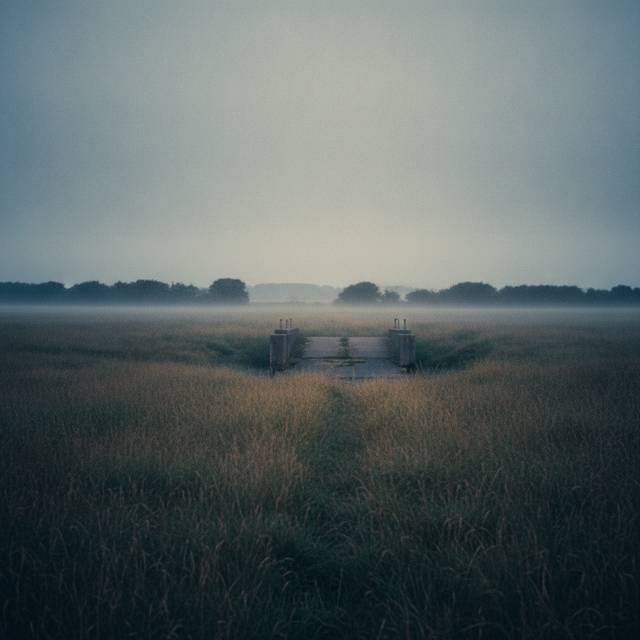
Councillors confirmed this week that the Haddenham Ferry Terminal remains, in their words, “ahead of projected readiness,” a figure independently verified by nobody, according to a report commissioned by the council from itself and printed, at cost, by the deputy council leader's brother-in-law's print shop.
A newly formed body, the Bucks Institute for Coastal Preparedness, whose three members include the deputy council leader, his brother-in-law, and a man who once went to Cornwall, has concluded that Haddenham faces a “statistically non-zero” risk of sea level rise by 2056, a figure the Institute described as “impossible to disprove, which is really the whole point.” The Institute's full findings run to four pages, three of which are the cover.
“People said we were mad to landlock a ferry terminal,” said a spokesperson, who declined to be named on the grounds that nobody would believe them regardless. “By 2056, when the waters rise, we will be ready. Everyone else will be scrambling. We will already have a car park.”
Officials were keen to stress, unprompted and three separate times during Tuesday's briefing, that this puts the terminal a full four months ahead of HS2, which remains on course, the council noted with some pride, to reach Birmingham by the end of that same year.
Asked how the sea might reach a village forty miles from the nearest coastline, the spokesperson cited “ongoing climate unpredictability” and asked that the question not be printed, a request the Herald is honouring by printing it in full.
The terminal's siting, planners add, is not solely about sea level. Council documents confirm Haddenham has also been earmarked as a potential inland freight hub for Europa, a proposed pan-European reconstruction project expected to begin, per the same documents, “once the current unpleasantness on the continent has run its course,” a phrase officials confirmed does in fact refer to the Third World War, delivered with the same flat certainty as a car park resurfacing update. “We didn't want to get caught out again,” said the spokesperson, who did not elaborate on what, precisely, the council had been caught out by the first time, or when.
Not everyone is convinced. A rival group, Haddenham Residents Against The Terminal, or HRATT, has collected what it describes as “a significant number” of signatures against the project, a figure it later revised down to eleven, then down again to seven once two members remembered they'd actually signed in favour by mistake. The group's founder, addressing this newspaper from a garden chair positioned directly in front of the site hoarding, described HRATT's position as “implacable opposition,” before conceding that his wife had “come round to it a bit, if we're honest, once she saw the car park plans.”
The council's written response to HRATT, obtained by this newspaper after someone left a printed copy on a bench, addresses each of the group's seven concerns in turn, by hand, in the margin. Concern one, “there is no sea,” is marked “yet.” Concern four, “nobody asked us,” is marked “correct.” Concern seven is entirely illegible and appears, on close inspection, to have a small drawing of a boat next to it.
The project, originally costed at four figures and a packet of biscuits, has since grown to a sum the council will describe only as “considerable, and frankly none of your business.” Independent observers note that the growth follows a familiar shape, unverifiable costs, theoretical benefits, and a beneficiary list that narrows, at every stage, to the small number of people already close enough to the council to bill it. A former councillor, who left local politics in 2019 and now runs a consultancy advising councils on, among other things, ferry terminals, described this as “just how it works, everywhere, always, and anyone who tells you otherwise hasn't been paying attention.” Asked whether that made local politics, in a country this broke, essentially a way of laundering public money through increasingly implausible infrastructure, he agreed, after a pause, that this was “one way of putting it,” adding that it was also, in his experience, “more or less the only reason anyone still bothers standing for the parish council.”
A dedicated helpline, set up to field residents' questions, has received exactly one call, from a man wanting to know whether the car park machine would take contactless, followed immediately by a second call, from the same man, apologising for calling twice and asking whether that would go on his record.
A public consultation is planned for early next year, at a venue yet to be confirmed, on a date yet to be confirmed, regarding a body of water which, on current evidence, has yet to so much as express interest.